
Why preparation matters for this inspection
A 4-point is quick on site, about 45 minutes to an hour. Most of what slows it down, or leaves blanks on the form, is missing dates and blocked access. Both are easy to fix ahead of time if you know what the form asks.
This guide walks through the current Citizens 4-Point Inspection Form (Insp4pt 03 25). Citizens describes it as the minimum data its underwriters need, and says any other report must include "at least this level of detail." If your insurer uses its own form, the preparation is almost the same. Citizens itself accepts other forms as long as they carry the same information and photos (Citizens FAQ).
One note before you start: Citizens' FAQs say its 4-point requirement does not apply to condominium or tenant policies. If you are insuring a condo unit, ask your agent whether you need one at all.
The fields that need dates
The inspector can see the equipment. What the inspector cannot see is when it was installed or last updated. These are the lines on the form that ask for a date, age or year:
| Section | What the form asks | Where the answer usually comes from |
|---|---|---|
| Top of form | Actual year built | Property records, your closing papers |
| Electrical | Panel age and year last updated, for the main and any second panel | Electrical permit, electrician's invoice |
| HVAC | Age of system, year last updated, date of last servicing or inspection | Equipment data plate, service receipt, mechanical permit |
| Plumbing | Age of supply piping and drain piping (original, completely or partially re-piped), year PEX was installed, age of water heater | Plumbing permit, re-pipe invoice, water heater label |
| Roof | Roof age, date of last roofing permit, date of last update, full or partial replacement and percent replaced | Roofing permit, roofer's contract and invoice |
The roof dates matter twice over. Florida's roof age statute counts age from the last date the whole roof surface was built or replaced, and some insurers set eligibility lines by roof age. We explain both in how roof age affects insurance in Florida.
For HVAC, Citizens asks for photos of the equipment "including dated manufacturer's plate," so the inspector will photograph the label. A service receipt from your HVAC company fills in the "date of last servicing" line, which the plate cannot.
How to find install and permit dates
If you do not have the paperwork, the permit record is the next best thing. It is public, it has a date, and insurers can check it.
Manatee County
Manatee County's Development Services Department offers permit record search by address, permit number or parcel ID. Its step-by-step instructions say you can search records "without even needing an account": go to the county's Accela Citizen Access portal, choose Search, then Building Permits.
Sarasota County
Sarasota County's permit search lets you look up a property by address or parcel ID, then narrow results by permit type or date range.
Inside city limits
Cities with their own building departments keep their own records. For a City of Sarasota address, for example, use the City of Sarasota permit search. If you are not sure who issued a permit, check with the county first.
What to look for
- Roof: a reroof or roof replacement permit, and whether it covered the whole roof or one section.
- Electrical: a service change or panel replacement permit.
- Mechanical: a permit for an AC or heat pump changeout.
- Plumbing: a re-pipe permit, and a water heater replacement permit if one was pulled.
Write down the permit number and the final inspection date for each. If you are buying, ask the listing agent for the same records, or for the seller's invoices, as soon as you are under contract.
Clear the access points
The inspector needs to see and photograph specific things. Citizens lists the minimum photos on the form: each side of the house, each roof slope, the water heater including its TPR valve, the plumbing and drains under the cabinets, exposed valves, the main electrical panel with its interior door label, the electrical box "with panel off," and every hazard or deficiency noted. Its FAQ adds HVAC equipment with the dated manufacturer's plate.
Working backward from that list, here is what to clear:
- Electrical panel. Move anything stacked in front of it or hanging over it. The Citizens form calls for a photo with the inner cover off, so the inspector needs room to work. If there is a second panel or subpanel, know where it is.
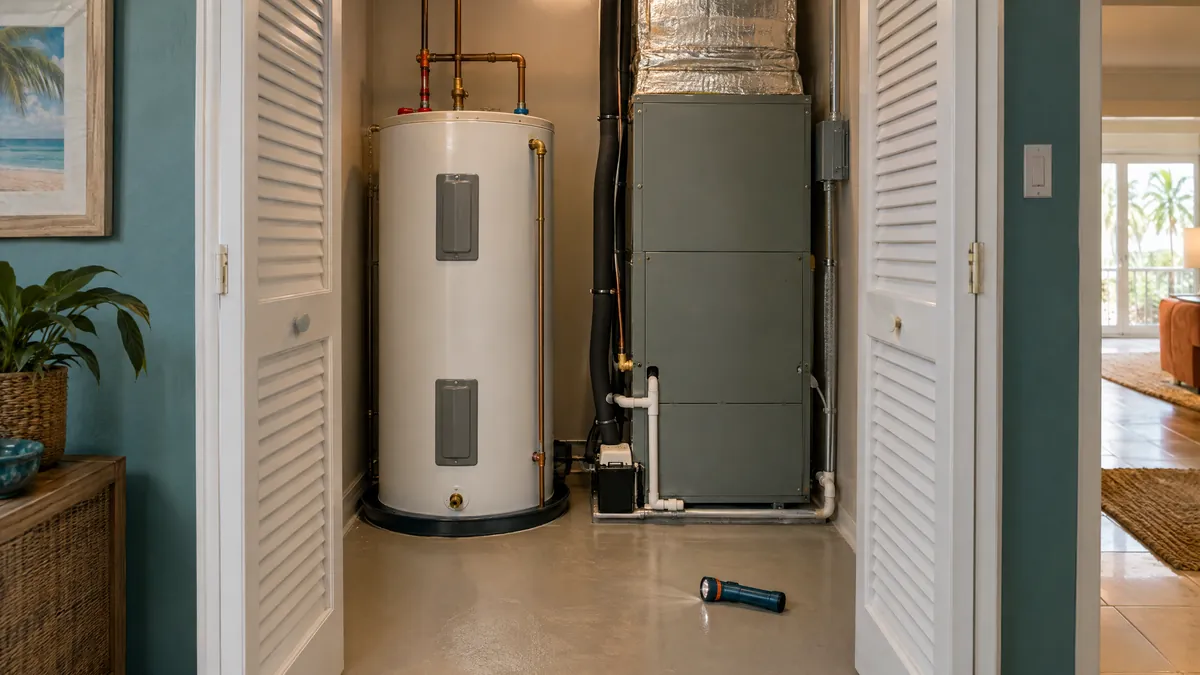
- Water heater. Make the tank, its label and the TPR valve on the side or top reachable. If it is in a closet, empty the closet floor.
- Under every sink. Take out cleaning supplies so the supply lines, shut-off valves and drains can be seen and photographed.
- Main water shut-off and exposed valves. Know where the main shut-off is and make sure it is not buried behind plants or storage.
- HVAC air handler and outdoor unit. The form asks whether the condensate line or drain pan shows signs of blockage or leakage, so the inspector needs to see the air handler, not just the thermostat. Clear the closet or garage space around it. Keep the path to the outdoor unit open.
- Attic hatch. The roof section asks about leak signs at the underside of the decking. Clear the closet shelf or garage space under the hatch.
- Outside. Each side of the house is photographed, so open gates and put pets inside.
- Appliance connections. The form rates the plumbing connections at the dishwasher, refrigerator and washing machine, so leave those areas reachable.
Also make sure the utilities are on. The form asks whether the HVAC is in good working order and whether breakers are tripping or fuses blowing, and those are hard to judge in a house with the power or water off.
Know what the inspector will note
You do not need to fix anything before the inspection to get an accurate report. But some items are worth knowing about in advance, because the form has a specific line for them.
On the electrical side, the form asks for the panel brand and model and flags fuses, cloth or knob and tube wiring, and single-strand aluminum branch wiring. Our guide to panels and wiring Florida insurers flag covers which brands insurers name and what to do about them. On the plumbing side, it records pipe materials, including polybutylene, galvanized and cast iron, which insurers treat differently.
If you already know about a leak or a hazard, Citizens' advice is to fix it before you apply: its Inspections page says serious hazards or deficiencies, "such as exposed wiring, active leaks or evidence of leaks," should be repaired before an application is submitted.
What happens after the inspection
The inspector documents. The form records ages, types, conditions and hazards, with photos, and the inspector signs it with a Florida license number. It does not pass or fail your house.
The insurer decides. The form's own wording is that underwriting "will rely on" it and that the information "only is used to determine insurability." Citizens also tells agents to review each 4-point before submitting it, and says agents may not submit applications for homes with electrical, heating or plumbing systems not in good working order or with existing hazards.
The clock starts. For a new Citizens application, the report must be dated within the 12 months before the application is submitted (Citizens FAQ). If you are shopping for coverage, keep that window in mind before ordering a new one.
High Tide delivers reports digitally within 24 hours, typically the next morning, so your agent can start quoting quickly. When you are ready, the details on scheduling a 4-point inspection are on our service page: $175 on its own, $125 with a home inspection.
Your checklist
- Gather permit numbers or invoices for the roof, panel, HVAC, re-pipe and water heater.
- Look up missing permits on the Manatee, Sarasota County or city portal.
- Clear the panel, water heater, under-sink cabinets, air handler and attic hatch.
- Leave utilities on, open gates, and secure pets.
- Fix known leaks or hazards before you apply, and confirm your carrier's rules with your agent.