What the 4-point electrical section records
Before getting into brand names, it helps to know what the inspector is actually filling in. The electrical section of the current Citizens 4-Point Inspection Form (Insp4pt 03 25) asks for:
- Panel type: circuit breaker or fuse, for the main panel and any second panel.
- Total amps, and whether the amperage is sufficient for current use.
- Wiring flags: cloth wiring, active knob and tube, and branch circuit aluminum wiring (with details of any remediation).
- Hazards present: blowing fuses, tripping breakers, empty sockets, loose wiring, improper grounding, corrosion, over fusing, double taps, exposed wiring, unsafe wiring, improper breaker size, scorching, or other.
- Supplemental information: panel age, year last updated, brand and model, and the wiring types present (copper, copper-clad aluminum, single-strand aluminum, multistrand aluminum, cable types, cloth-covered or rubber-insulated wiring).
- Overall condition: satisfactory or unsatisfactory.
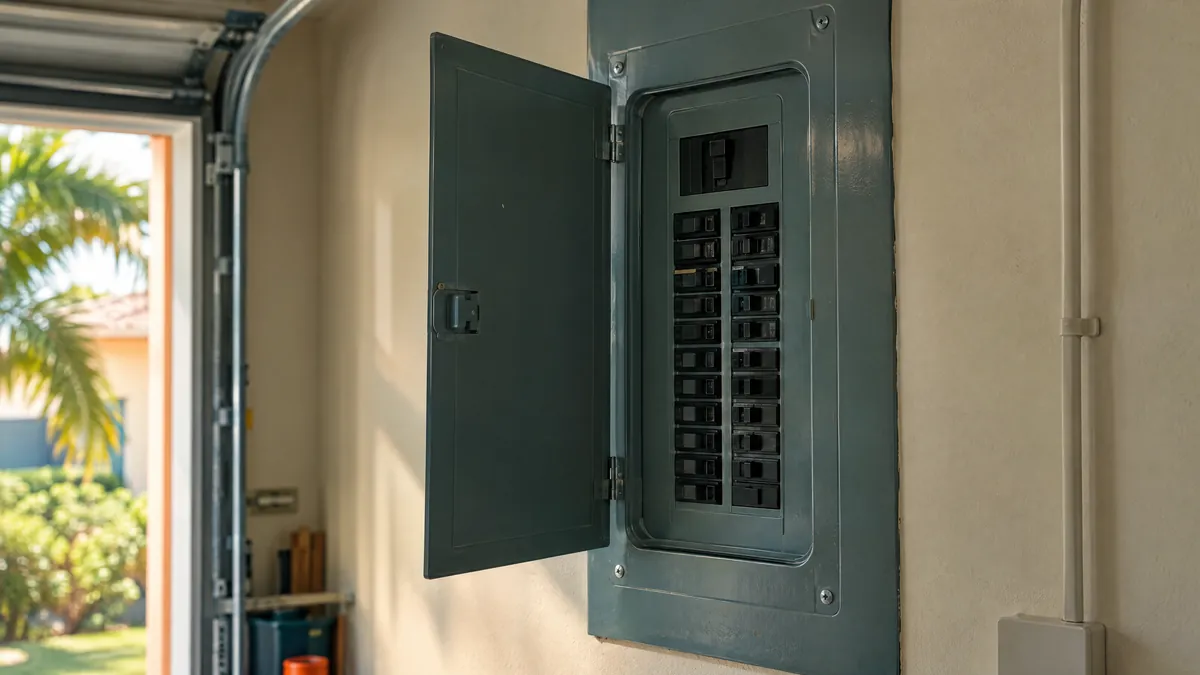
The required photos include the open main panel with its interior door label, and the "electrical box with panel off," meaning the inspector removes the panel's inner cover (the dead front) to look at the breakers and wiring behind it.
Notice what is missing: the Citizens form does not list any panel brand as bad. It asks for the brand and model, and it asks about hazards. The underwriter at each insurer decides what that brand means for eligibility.
Which panel brands Florida insurers name
Insurer underwriting guidelines are usually posted for agents, not the public, and they change. Two Florida carriers have posted guidelines publicly that name brands:
- Anchor's Florida homeowners underwriting reference guide (version dated December 2019) says risks with "Federal Pacific, Zinsco, Challenger, Stab-loc, & Sylvania panels are ineligible and require replacement," and that risks with fuses, knob and tube wiring or less than 100 amps are ineligible.
- Universal Property's Florida binding guidelines (10-24-18 edition) list "No Federal Pacific (includes Stab Lok), Zinsco, Sylvania-Zinsco, or Challenger-Zinsco Boxes" and "No Fuses," along with no aluminum branch wiring, cloth or knob and tube.
Those documents are several years old and may not match either company's current rules. Treat them as examples of how carriers write these rules, and ask your agent for the current guideline of the insurer you are applying to.
Citizens, for its part, sets a floor on service size: its FAQ says "all new-business applications must meet a minimum requirement of 100 amps" (Citizens FAQ).
Federal Pacific and the Stab-Lok breaker
Federal Pacific Electric (FPE) panels with Stab-Lok breakers are the best-known name on these lists. The history behind the reputation is in a U.S. Consumer Product Safety Commission release from 1983, revised in 2011. The CPSC says its investigation began in 1980 when the parent company reported that "many FPE circuit breakers did not fully comply" with Underwriters Laboratories requirements, and that "Commission testing confirmed that these breakers fail certain UL calibration test requirements." Calibration tests check whether a breaker trips within set time limits when a circuit is overloaded.
The same release is careful about what it does not say. The CPSC closed the investigation "without making a determination as to the safety of FPE circuit breakers," citing cost and insufficient data. So there was no recall. Insurers that exclude these panels are making an underwriting call, not enforcing a government finding.
How to spot one. InterNACHI's guide to electrical service panels says FPE panels should carry one of these labels, if it has not been removed: Federal Electric, Federal Pacific Electric, Federal NOARC, Federal Pioneer, FPE, FPE-Stab-Lok, or Stab-Lok. Stab-Lok is Federal Pacific's breaker line, which is why guidelines list the names together.
Zinsco and Sylvania-Zinsco
InterNACHI groups Zinsco with FPE: panels made by either "have a reputation for being problematic and further evaluation by a qualified electrician is recommended." It says a Zinsco panel can generally be identified by "a blue and silver 'Zinsco' label inside the panel, and an embossed 'Magnetrip' label at the top of the panel face."
The Sylvania and Challenger names show up on the same insurer lists, often joined to Zinsco as in Universal's "Sylvania-Zinsco" and "Challenger-Zinsco." We could not find a government or InterNACHI source explaining the failure history of those two brands, so we will not guess at it here. What matters for a policy is simpler: if the brand is on your insurer's list, expect to be asked to replace the panel.
Fuses, amperage and old wiring
Brand is only part of the electrical section. The other items the form flags can matter just as much.
Fuse panels
The form asks, first thing, whether the panel is circuit breaker or fuse, and it has hazard boxes for "blowing fuses" and "over fusing." Both carrier guidelines above list fuses as ineligible. A fuse box that works can still be a problem for coverage with carriers like these.
Single-strand aluminum branch wiring
Between about 1965 and 1973, single-strand aluminum wire was sometimes used in place of copper for branch circuits, according to InterNACHI's article on inspecting aluminum wiring. The concern is the connections. The CPSC's publication Repairing Aluminum Wiring reports that homes built before 1972 and wired with aluminum "are 55 times more likely to have one or more wire connections at outlets reach 'Fire Hazard Conditions' than homes wired with copper."
Citizens' rule is specific. Its aluminum wiring FAQ says multi-strand aluminum wiring is acceptable, but single-strand aluminum branch circuit wiring is not acceptable without documented remediation, meaning either a complete rewire with copper or every aluminum-to-copper connection repaired with the COPALUM crimp method or the AlumiConn connector method. It adds that Leviton products are not accepted for this repair. The form requires separate documentation of the remediation, certified by a licensed electrician.
Aluminum on the main service is treated differently from single-strand branch wiring. Anchor's guide, for example, says aluminum is acceptable for service entrance wiring and dedicated 220 circuits.
Cloth and knob and tube wiring
InterNACHI's knob-and-tube article says the system was in common use from about 1880 to the 1940s, is "not inherently dangerous," and that its risks come from age, improper modifications and insulation packed around the wires. It also has no ground wire. The 4-point form asks about cloth wiring and active knob and tube separately. Both carrier guidelines above exclude knob and tube, and Universal's also excludes cloth wiring.
What you can do if your panel is on the list
Have a licensed electrician look at it. An inspector documents what is visible. An electrician can tell you whether the panel, breakers and wiring can stay, need repair, or need replacement, and can pull the permit for the work.
Keep the paperwork. If the panel is replaced, the next 4-point should show the new brand, the panel age and the year last updated. A closed permit and the electrician's invoice back that up. For aluminum wiring remediation, Citizens wants a licensed electrician's certification of the work.
Do not reset and ignore. The CPSC's advice for all breakers and fuses is to find out why a fuse blows or a breaker trips rather than simply resetting it, and to consult a licensed electrician when in doubt.
Do it before you apply. Citizens says serious hazards, such as exposed wiring, should be repaired before an application is submitted (Citizens Inspections).
Plumbing is the other system where materials alone can decide eligibility. See our guide to polybutylene, galvanized and cast iron pipes. If you are getting ready for the inspection itself, including clearing space around the panel, start with what to have ready before the 4-point.
The short version
- The 4-point form records panel brand, type, amps, wiring and hazards. It does not grade brands. Your insurer does.
- Federal Pacific (Stab-Lok), Zinsco, Sylvania and Challenger panels, fuse boxes, and unremediated single-strand aluminum branch wiring are the items named in the Florida carrier guidelines we reviewed.
- A licensed electrician's evaluation, and documentation of any replacement or repair, is what moves an application forward.
Joanna holds InterNACHI's Electrical Inspector certification, and High Tide's 4-point inspection documents the panel, the wiring and any visible hazards with photos. It is $175 on its own, or $125 added to a home inspection. This article is general information, not insurance advice, so confirm your carrier's current rules with your agent.