
Infrared Inspection
in Lakewood Ranch.
Thermal imaging that finds hidden moisture, electrical hot spots, and missing insulation.
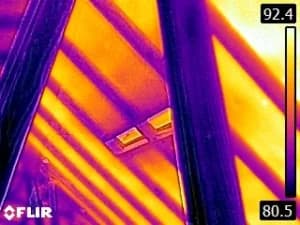
Infrared inspection in Lakewood Ranch uses a thermographic camera to detect temperature differences that reveal hidden moisture, electrical hot spots, missing insulation, and HVAC duct leaks: problems that don't show up to the naked eye. Joanna is a Certified Thermographer with 40+ years in construction, and offers a full thermal imaging scan as a $250 add-on, on its own or alongside a home inspection.
The purpose of an infrared scan is to find the issues that hide behind walls, above ceilings, and inside attics. With our calibrated infrared camera we can see moisture, missing or settled insulation, electrical hot spots, HVAC duct leaks, and overheating breakers. Problems that wouldn't be visible to a flashlight-only inspector.
Many of these problems go undetected during a traditional home inspection because they occur out of sight. Left alone, they become big problems. A small roof leak turns into ceiling collapse, a hot breaker becomes a fire, a missing insulation patch doubles your electric bill. Infrared is how we catch them while they're still small.
"While not seen by the naked eye, the potentially troublesome areas could become big problems later. A thermal scan is the fastest way to catch them while they're still small."
"Joanna is the ultimate professional! She performed my home inspection when I bought my place and recently a 4 point inspection for new home owners insurance. She is responsive, knowledgeable and thorough. Best of all she is a very nice person. I highly recommend her to anyone who needs this service."
Common
questions.
- What does an infrared scan actually show?
- Temperature differences. Cool spots on a ceiling typically indicate moisture. Hot spots on an electrical panel indicate overheating connections. Cold streaks in a wall indicate missing insulation. Warm patches on an exterior wall indicate HVAC duct leaks. We interpret what the colors mean.
- How much does a thermal imaging scan cost?
- A full thermal imaging scan is $250, whether you book it on its own or add it to a home inspection. It's a great add-on when you want extra certainty on moisture, insulation, and electrical, or when you're investigating a specific issue on a home you already own.
- Does infrared work through walls?
- Infrared detects surface temperature, not what's behind the surface. But moisture, missing insulation, and overheating wiring all create surface temperature differences that show up on the scan. So in practice, it finds problems behind the wall by reading the wall itself.
- Are there limits to what infrared can find?
- Yes. Infrared isn't magic. It works best when there is a temperature difference between the problem and its surroundings, which means it performs better on warm days, after the HVAC has been running, and on the side of the house in shade. We schedule and interpret the scan to maximize sensitivity.
- Can I see the thermal images in my report?
- Absolutely. When we perform a thermal scan and find something worth flagging, the thermal image goes directly into your report alongside the standard photo, so you can see exactly what we're describing.
You might also need
Mold Testing
Air-quality sampling, surface testing, and moisture mapping for SW Florida's mold-prone climate.
Home Inspection
Full-system inspection with 24-hour digital report, from $450.
Sewer Scope Inspection
Camera inspection of the lateral sewer line. Find root intrusion, breaks, and bellies before closing.
Ready to schedule your infrared inspection?
Book online in under a minute. Same-day report. Call or text Joanna directly at 941-779-4822.