
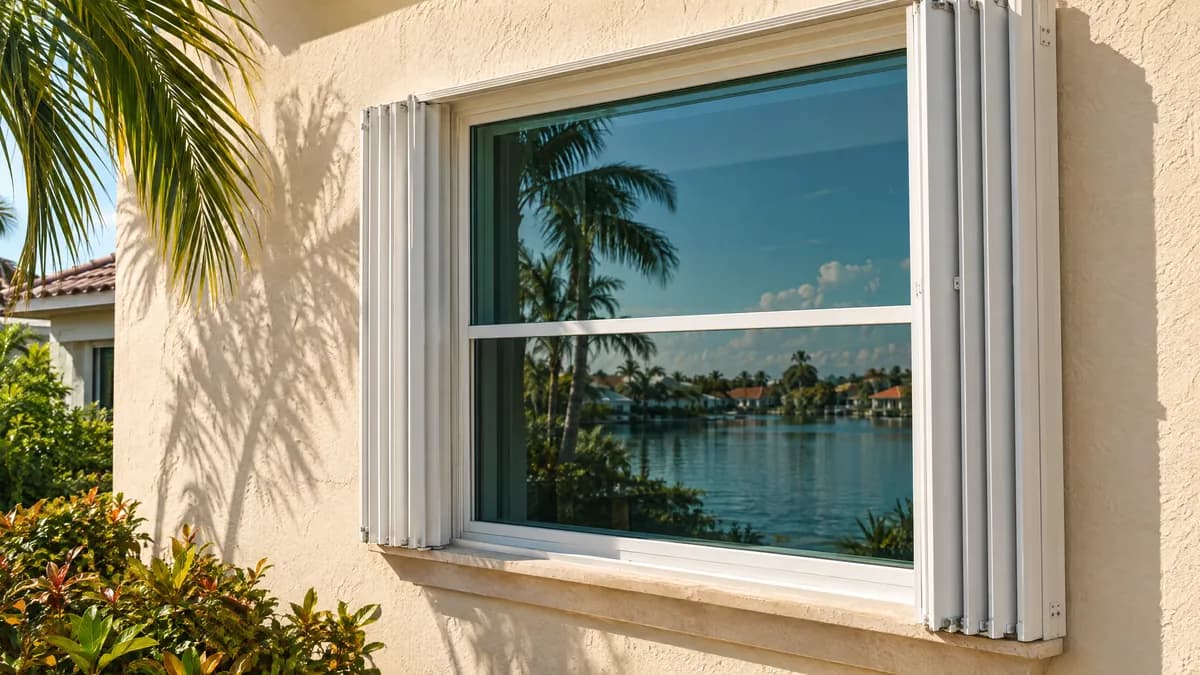
Why openings get their own question
Windows and doors are where a house is most likely to be breached in a hurricane. The 2024 Residential Wind-Loss Mitigation Study prepared for the Florida Office of Insurance Regulation calls opening protection "perhaps the greatest single loss mitigation strategy for a building," and explains why:
"Once a window or door fails, the pressure inside of the structure increases due to the breach in the building envelope. The positive pressure inside of the building produces an additive load on the building envelope. The increase in load can be up to twice the loads the building experiences without a breach of the envelope."
That extra load can then overload the roof and the remaining windows and doors. So the wind mitigation form does not ask whether a house has impact windows. It asks for the weakest protection on any opening.
What counts as an opening
Opening protection is question 9 on the current OIR-B1-1802 form, effective April 1, 2026. The form says the category "includes all openings in the wall and roof including windows, doors, sliding glass doors, skylights, and garage doors. Gable roof vents and other roof vents are not included."
The inspector fills in a chart with a column for each type of opening:
- Glazed openings (openings with glass): windows or entry doors, garage doors, skylights and glass block.
- Non-glazed openings (solid, no glass): entry doors and garage doors.
A garage door with a row of glass panels is a glazed opening. A solid garage door is non-glazed. That distinction matters for the final answer.
The protection levels in the chart
Each row of the chart is a level of protection. The inspector marks every level in use for each type of opening, then works from the weakest.
| Level | What the form means |
|---|---|
| A | Verified cyclic pressure and large missile impact (9 lb missile for windows and doors, 4.5 lb for skylights) |
| B | Verified cyclic pressure and large missile impact (4 to 8 lb for windows and doors, 2 lb for skylights) |
| C | Verified plywood or OSB panels meeting Table 1609.1.2 of the 2007 Florida Building Code |
| D | Verified non-glazed entry or garage doors showing compliance with ASTM E 330, ANSI/DASMA 108 or PA/TAS 202 for wind pressure |
| N | Products that appear to be A or B but are not verified, or other coverings that cannot be identified as A, B or C |
| X | No windborne debris protection |
| Z | Damaged openings in need of repair or replacement |
Level A lists the accepted test standards: Miami-Dade County PA 201, 202 and 203, Florida Building Code TAS 201, 202 and 203, ASTM E 1886 and ASTM E 1996, or SSTD 12. For garage doors only, the form adds ANSI/DASMA 115. Products must also be "listed as wind borne debris protection devices in the product approval system of the State of Florida or Miami-Dade County."
How the final answer is chosen
The answer has two parts.
- A letter for the glazed openings. The form checks one answer (A, B, C, N, X or Z) "based on the weakest form of protection (lowest row) for any of the glazed openings." If every window, glass door and skylight is Level A, the letter is A. If a single window has no protection, the letter is X.
- A number for the non-glazed openings. Under A, B, C and N, a .1, .2 or .3 records the solid doors. For example, under A: A.1 means all non-glazed openings are also Level A (or there are none), A.2 means one or more are Level D with none weaker, and A.3 means one or more are Level B, C, N, X or Z.
Two examples show how this plays out:
- A house with impact-rated windows and sliding doors throughout, and a solid garage door with no rating: the glazed openings earn A, and the unrated garage door makes it A.3.
- The same house with one original, unprotected bathroom window: the answer drops to X, regardless of everything else.
That is why one opening can change the classification. The form does not average.
Why the garage door so often decides it
A solid garage door is a large opening, and it is easy to leave out of a window upgrade. The ARA study noted that "there are many homes with protection over windows and other glazed openings but no additional protection over solid (non-glazed) entry doors or garage doors."
If you are replacing windows for wind protection, ask about the garage door and the entry doors at the same time. A garage door with glass panels is a glazed opening, so it can pull the letter down, not just the number.
Impact windows vs. shutters on the form
The form treats impact-rated glass and impact-rated shutters the same way. Level A and B both cover "impact resistant coverings or products listed as wind borne debris protection devices." What matters is the verified rating, not the type:
- Impact windows and doors rated to the Level A or B standards can qualify at that level.
- Rated shutters (accordion, roll-down, panels and similar) can qualify at A or B if they are listed and verified, but they only count for the openings they actually cover.
- Plywood or OSB panels can qualify at Level C only if they meet Table 1609.1.2 of the 2007 Florida Building Code.
- Shutters with no documentation land at N, even if they look like the real thing.
What proves an impact rating
This is where many wind mitigation reports lose points. A product that "appears to be A or B but [is] not verified" is Level N. Verification usually comes from:
- Florida product approval. Products approved statewide carry an FL number you can look up in the Florida Building Commission's product approval search.
- Miami-Dade Notice of Acceptance (NOA). Miami-Dade approvals can be looked up in the county's product control search.
- Labels on the product. Rated products may carry a label or sticker. The ARA study shows accordion shutters with a Miami-Dade sticker and notes such labels contain "the words 'Dade County Product Approved' or equivalent."
- The right standard for garage doors. The form looks for ANSI/DASMA 115 for a Level A garage door, and ASTM E 330, ANSI/DASMA 108 or PA/TAS 202 for a Level D (wind pressure only) entry or garage door.
A label can be painted over, peeled off or hidden behind trim. That is why paperwork matters.
Why receipts and permits help
The form's own instructions say "any documentation used in validating the compliance or existence of each construction or mitigation attribute must accompany this form." For openings, the strongest paperwork is:
- The building permit for the window, door, garage door or shutter installation. A permit ties the installation to your address and a date, and the permit file may identify the product.
- The contractor's invoice or contract, ideally listing the manufacturer, model and FL or NOA number for each opening.
- The product approval document printed from the state or Miami-Dade search.
Gather these before the inspection and have them ready. If you bought the house recently, ask the seller or your agent whether the previous owner left any window or shutter paperwork.
Condition counts too
The current form added Level Z for damaged openings. Question 9 states: "All openings (windows, doors, and skylights) must be in good condition. Buildings with openings that need replacement do not qualify for wind mitigation rate differentials, regardless of the presence/absence of other features." A cracked impact window or a damaged garage door is not a minor note on this form.
For the full form in order, see our question-by-question guide to the OIR-B1-1802. Roof shape is its own question, covered in our hip roof and gable roof comparison.
If you want your openings documented, our Wind Mitigation Inspection page lists the price: $225 on its own, or $175 when added to a home inspection. How much a given answer is worth on your premium depends on your insurer's filed discounts, so confirm that with your agent.
The short version
Every window, door, sliding door, skylight and garage door counts, and the form records the weakest one. The letter (A, B, C, N, X or Z) comes from the glazed openings, and the number (.1, .2 or .3) comes from solid entry and garage doors. A single unprotected window drops the answer to X, and an unrated solid garage door is a common reason a house with impact windows ends up at A.3. Labels, FL or Miami-Dade approval numbers, permits and invoices are what turn "appears to be" into "verified."