
First, is it already included?
Usually not, and it is worth asking any inspector directly whether thermal imaging is part of their home inspection. A standard home inspection is a visual one. The InterNACHI Standards of Practice define a home inspection as "a non-invasive, visual examination of the accessible areas" of a home, and they do not call for thermal imaging.
At High Tide Home Inspections, the full thermal imaging scan is a separate $250 add-on. You can book it with a home inspection or on its own, for example on a home you already own where you are chasing a specific problem. Joanna Furuglyas, who owns High Tide and does the inspections, is a Certified Thermographer.
So the real question is not whether you get it for free. It is whether $250 buys you information you would not otherwise have on this particular house.
What an infrared camera actually measures
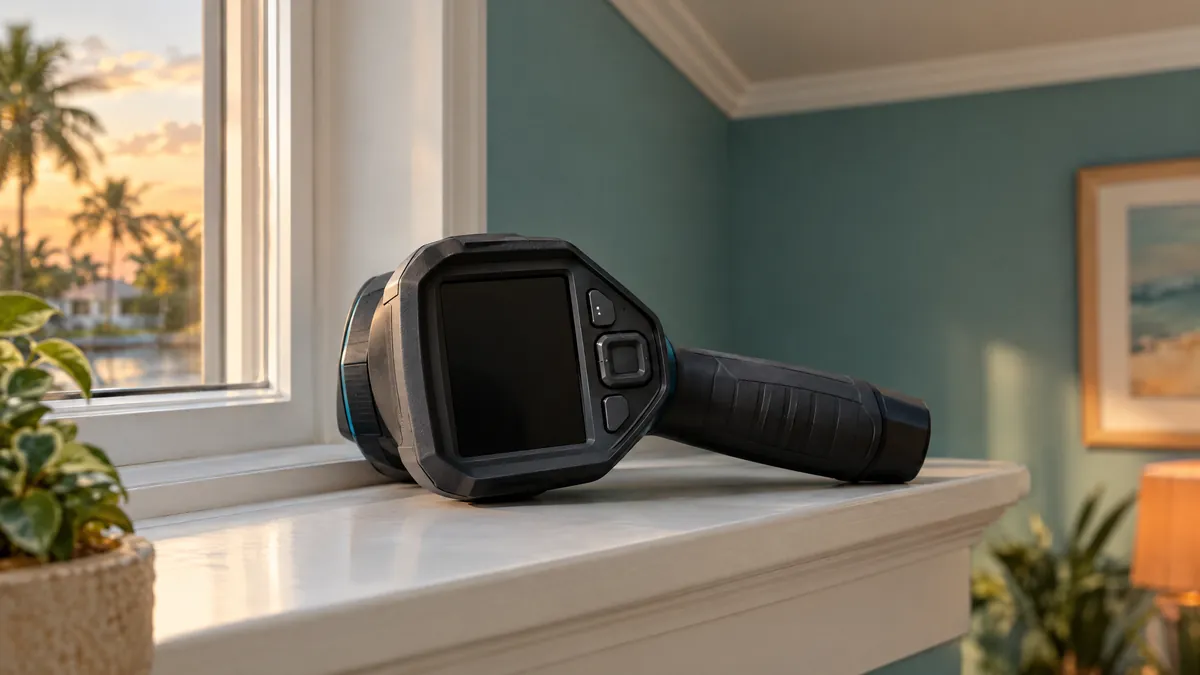
An infrared camera does not see through walls. InterNACHI's overview of IR cameras for inspectors puts it plainly: thermal images "show surface-heat variations." The camera reads the heat coming off a surface and turns small temperature differences into a color picture.
That sounds limited, but a lot of hidden problems change the temperature of the surface in front of them:
- Moisture. Wet drywall or insulation reads cooler than the dry material around it. InterNACHI's guide to inspecting for moisture intrusion notes that "the apparent temperature of wet spots will be lower than that of building materials."
- Missing or displaced insulation. A bare patch in the attic lets heat through, and the ceiling below shows it as a stripe or block that does not match.
- Overheating electrical parts. A loose connection or overloaded breaker runs hotter than its neighbors.
- Air leaks and duct problems. Conditioned air escaping from a duct or around an opening leaves a temperature pattern on nearby surfaces.
InterNACHI's thermography overview lists the same core uses: finding deficient insulation, air leaks, moisture intrusion "when used with a moisture meter," overheating electrical systems, roof leaks and HVAC defects.
Where it earns its keep in a Florida home
Every house is different, but these are the situations where a scan most often changes what you know.
A history of roof or window leaks. Stains on a ceiling or around a window frame tell you water got in at some point. They do not tell you whether it is still getting in, or how far it spread. A scan can show whether the area around the stain reads differently from the rest of the ceiling, and a moisture meter can then confirm whether it is wet today.
Recent storm activity. After heavy rain or wind, water can travel along framing and show up far from where it entered. InterNACHI suggests thermal imaging after a water-damage event because it "can help document the scope of the damage, as well as find affected areas that may not be immediately obvious."
Attics that are hard to walk. Florida attics are hot, tight and often packed with blown insulation. Scanning the ceilings from below can point to gaps or compressed insulation in areas that are not safely accessible.
An older electrical panel, or a lot of add-on circuits. A scan of the panel and its connections can show a hot spot that looks perfectly normal to the eye. InterNACHI's guidance on thermal imaging reports puts electrical hot spots at the top of the repair list because they can lead to fires.
Ductwork in the attic. Where ducts run through a hot attic, a disconnected or leaking duct wastes cooling and can drip condensation onto the ceiling below. The scan can make that visible.
A home you are not sure about. Sometimes the house looks fine but something is off: a musty room, a soft spot in the drywall, a ceiling that was just painted. Infrared is a reasonable way to look further without cutting anything open.
Conditions that make a scan more reliable
Because the camera reads differences, it needs a difference to read. A wet spot at exactly the same temperature as the dry wall beside it will not show up. A few things help:
The air conditioning is running. In Florida, the difference between a cooled interior and a hot exterior is usually what makes moisture, insulation gaps and duct leaks stand out. A vacant house with the AC shut off can leave everything at a similar temperature. If the home you are buying is vacant, ask the listing agent to have the AC running ahead of the inspection.
Systems are under normal load. Electrical problems show up best when circuits are actually carrying current, and HVAC problems when the system is running.
The inspector reads the image, not just the colors. InterNACHI warns that shiny and reflective surfaces have low emissivity, and that "images of reflective surfaces may be affected by a hot light bulb elsewhere in the room," which could be misread as a temperature difference. Scanning from more than one angle and knowing the materials is part of the job.
Anything suspicious gets confirmed. A cool spot is a lead, not a finding. InterNACHI's method is to locate the anomaly with the camera and then confirm it with a moisture meter. A cool patch can also be an AC register blowing on a wall, a bit of missing insulation, or a spot of wet paint.
What infrared cannot tell you
It helps to be clear about the limits before you pay for it.
- It cannot see inside a wall. It reads the surface. A problem deep in a wall that does not change the surface temperature can be missed.
- It cannot see yesterday's leak. If a window leaks only in a driving rain and the wall has dried out, there may be nothing to see on a dry day.
- It does not identify mold. A scan can find the moisture mold needs, but it cannot tell you whether mold is growing or what kind. If that is your concern, see when mold testing is worth it for a Florida buyer.
- It is not a precise moisture measurement. InterNACHI's own articles describe inspectors working with "apparent" temperature. The camera points you to the spot; other tools confirm what is there.
So, is it worth $250?
A scan tends to be worth it when:
- the home has visible stains, fresh paint on ceilings, or a known leak history;
- it has been through recent storms, or the seller disclosed water events;
- it has an older electrical panel or a lot of modified wiring;
- the ducts and air handler are in the attic and the house has uneven cooling; or
- you want the most information you can get inside a short inspection period.
It adds less when the home is recently built, has no signs of water, and the budget is better spent on the forms your insurer or lender requires. If you are deciding between add-ons, what each inspection add-on costs and why Florida buyers need it puts the infrared scan next to the 4-Point, wind mitigation and WDO so you can prioritize.
When you want the scan, you can read more about High Tide's infrared inspection service, including what the report shows.
The short version
- Infrared is not part of a standard visual home inspection. At High Tide it is a $250 add-on, on its own or with an inspection.
- The camera reads surface temperature. It finds moisture, insulation gaps, hot electrical connections and duct problems because they change the surface temperature, not because it sees through walls.
- It works best with the AC running, systems under load, and every finding confirmed with a second tool such as a moisture meter.
- It is most useful on homes with stains, leak history, storm exposure, older electrical, or attic ductwork, and least useful on a newer home with no signs of water.